Driving from Germany to Turkey 2026: Which Border Crossing, How Many km, What Cost?
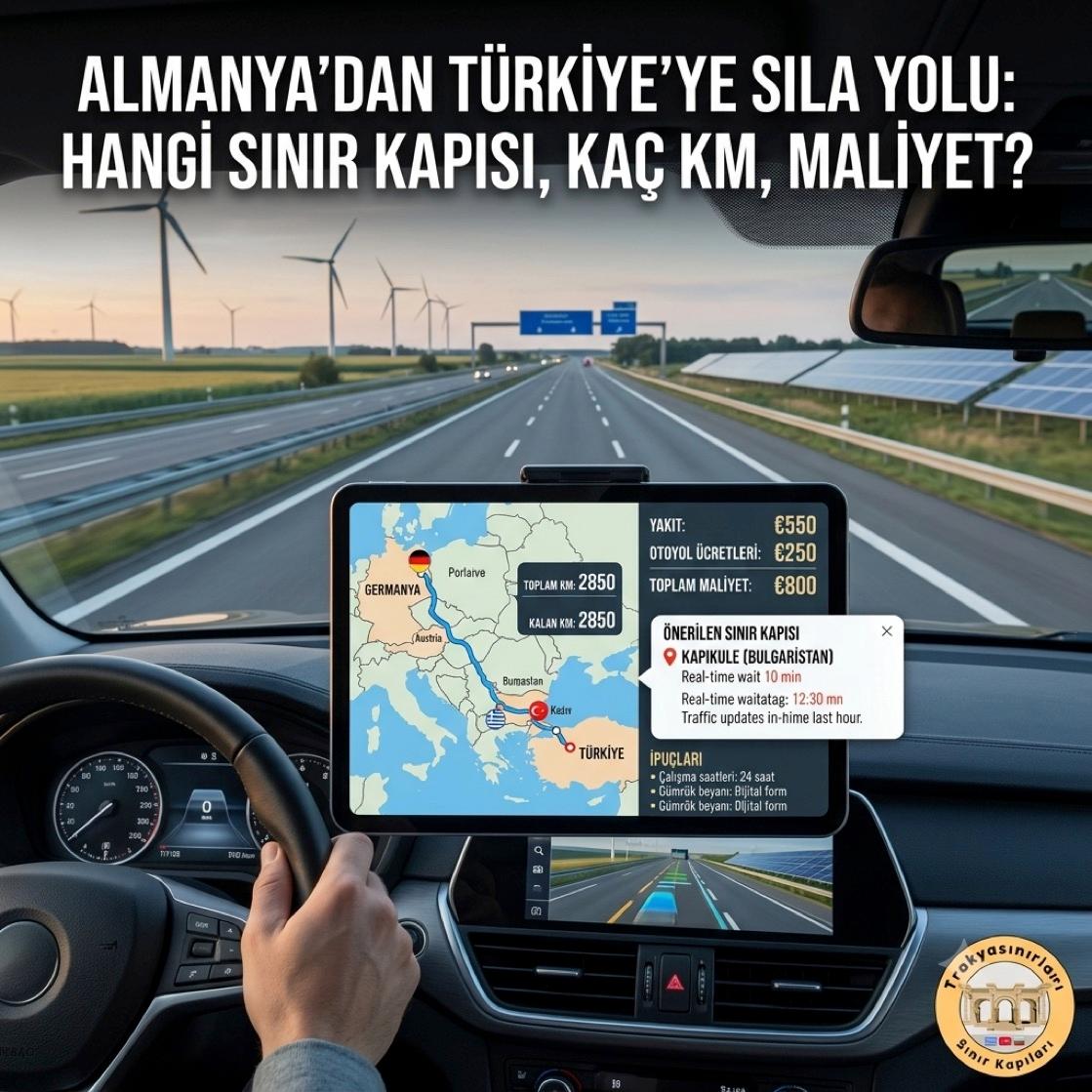
For the Turkish diaspora in Europe, the summer months are a special time, when homesickness and the excitement of reunion reach their peak. Every year hundreds of thousands of Turks living abroad set off by car from Germany and other European countries on a journey of several thousand kilometres. Known among Turkish expats as the "Sıla Yolu" (the journey home), this traditional trip can turn into an exhausting ordeal without proper planning, with long customs queues, unexpected vignette fines and the wrong choice of route.
As of 2026, new motorway updates, technological upgrades at the border crossings and changing cost items have reshaped the Sıla Yolu map. In this guide we set out the best-optimised routes, budget calculations and the latest situation at the border crossings for drivers searching for "Germany to Turkey by car" and "driving from Germany to Turkey". At trakyasinirlari.com, our aim is a safe and comfortable journey for you from the moment you set off until you enter Turkey. Your journey has two main options: the classic Serbia route and the alternative Romania route.
1. Introduction: The Main Routes for Driving from Germany to Turkey
Whichever part of Germany you set off from (north, south, west or east), once you have crossed Central Europe two main corridors open up ahead of you. The first and most popular is the transit route via Serbia, which offers almost uninterrupted motorway comfort. The second is the alternative via Romania, chosen by those who want to benefit from the more flexible border crossings of countries newly fully integrated into the Schengen area and to avoid congestion on Serbian motorways in the peak season.
Each route has its own advantages, speed limits, road quality and cost balance. When choosing, look not only at the total distance but also at when you travel (the June–July rush), who is in the car (waiting times are critical for families with children) and the current traffic at customs. Let us take a detailed look at these two routes for planning your "Sıla Yolu route 2026".
2. Route 1 (Classic): Germany → Austria → Hungary → Serbia → Bulgaria → Kapıkule
Among Turkish expats this route is known as the "Main Road" or "Classic Route". It is the road on which drivers leaving cities such as Frankfurt, Munich or Stuttgart feel most at ease, because the road signs and rest areas have fully adapted to the Sıla Yolu culture.
Distance and Driving Time
Starting from central Germany (for example Frankfurt), the total distance on this route to the Kapıkule border crossing near Edirne is around 2,200 km. Excluding waiting times at customs, the estimated net driving time in ideal road and weather conditions is 22 to 24 hours. For drivers' safety it is vital to take a break every 2-3 hours and, given the risk of hallucinations at the wheel, to take at least one long sleep break.
Motorways and Vignettes
The biggest advantage of the classic route is that almost 95% of it consists of modern motorways. But this comfort comes with a separate payment obligation in each country:
- Austria: Before entering the country, buy a digital vignette (Videomaut) or a physical sticker. Current durations and prices are on the Austria vignette page. Important: the A9 Pyhrn, A10 Tauern and A13 Brenner tunnels are tolled separately (€6.50-€13.00 per tunnel). You can buy the vignette online at asfinag.at. Fuel at Austrian motorway service stations is €0.30-€0.45 more expensive than off the motorway — if possible, buy only the minimum in Austria and fill up in Hungary or Bulgaria.
- Hungary: A fully electronic matrica (e-matrica) system applies. Cameras read your number plate, so you must buy it online before entering. For details and alternative crossings, see our Hungary border crossings page.
- Serbia: You take a ticket at the toll booth on entry and pay at the exit booth in cash (euros) or by credit card. Along the Serbia border crossings routes, speed is checked by calculating the average speed between motorway toll booths.
- Bulgaria: As soon as you cross the border, register a vignette for your number plate at an e-vinetka terminal. Driving without a vignette at the Bulgaria border crossings and on Bulgarian motorways carries a very high fine.
Order of Border Crossings
On this route you pass through these key crossings in order: Horgoš / Röszke (on the Hungary–Serbia border, one of the most congested crossings in summer), Gradina / Kalotina (the Serbia–Bulgaria border, the bottleneck where the stream of Turkish expats meets heavy truck traffic) and finally the famous Kapıkule, the gateway into Turkey.
The Journey Home from Austria: A Special Guide
For Turks living in Austria, the route home is somewhat shorter than from Germany and its strategic advantages are different. Setting off from Vienna, Linz, Graz or Salzburg, you have two main options:
Austria → Hungary → Serbia → Bulgaria → Kapıkule (Classic)
Leaving Vienna, you take the A4 motorway to the Hungarian border (Nickelsdorf/Hegyeshalom). From there you follow Hungary's M1 motorway towards Budapest and cross into Serbia at Szeged (Röszke/Horgoš). The total distance from Vienna to Kapıkule is about 1,150 km, with a driving time of 12-14 hours (excluding customs). The biggest advantage for those living in Austria is that they drive about 1,050 km less than those coming from Germany.
Austria → Hungary → Romania → Bulgaria → Kapıkule (Romania Alternative)
If there is a long queue at Serbian customs in summer, turning east after Hungary and travelling via Romania is a valid alternative for those coming from Austria too. Instead of entering Serbia at Szeged, you can cross into Romania at the Nădlac crossing on the Hungary–Romania border and continue towards Arad. This route is about 1,350 km and takes 16-18 hours, but once you have saved the time of the Serbian queue it gives you a net time gain. For the detailed route, see our Germany to Turkey via Romania guide.
Money-Saving Tip for Drivers from Austria (approximate prices, November 2026): Fuel costs €1.55/l on Austrian motorways, while it is €1.45/l in Hungary and €1.25/l in Bulgaria. Leaving Vienna with just enough fuel and filling up completely in Hungary (around Győr or Mosonmagyaróvár) saves about €5 on a 50-litre tank. Avoid buying fuel at Austrian motorway service stations — the price difference can reach 20-30%.
3. Route 2 (via Romania): Germany → Austria → Hungary → Romania → Bulgaria → Kapıkule
The "Germany to Turkey via Romania" route, popular in recent years with those looking for an alternative, continues east (into Romania) after the Szeged area of Hungary instead of turning south (into Serbia).
Distance and Driving Dynamics
If you choose this route, the total distance between Germany and Turkey rises to around 2,400 km. It is about 150-200 km longer than the classic route. Because of the structure of the road network, the net driving time on this route can rise to 26 to 30 hours.
Advantage: You avoid Serbia's strict customs searches, which sometimes take hours, and its high toll charges. Because Romania and Bulgaria have been full Schengen members since 1 January 2025, there are no routine passport checks at the Hungary–Romania and Romania–Bulgaria borders; crossings are much faster than on the Serbian line.
Disadvantages and Border Crossings
The motorway infrastructure in inland Romania is not yet complete. Carpathian mountain passes and winding single-lane village roads slow you down considerably and call for extra care when driving at night. To cross from Hungary into Romania, you use the Nădlac (A01 / A1) crossing. From there you have two options: head south through Romania and cross into Bulgaria via the Vidin bridge (Calafat-Vidin), or take the Ruse line via Bucharest (the Friendship Bridge). For detailed road analyses, see our Romania border crossings guide.
4. Kapıkule or Hamzabeyli: Which One on the Sıla Yolu?
The most crucial moment of the journey comes when you finish the Bulgarian motorway and approach the Turkish border. The vast majority of those driving home head straight for Kapıkule, also because the satnav sends them there.
Waiting Times in the Summer Season
Especially between 15 June and 15 September, at peak times when the outward and return journeys of Turkish expats overlap, waiting times at the Kapıkule border crossing can range from 6 to 12 hours. Waiting in a queue of cars in extreme heat with children can drain the energy of the whole trip.
The Hamzabeyli Alternative and Advice for the Diaspora
In the same busy periods, the Hamzabeyli border crossing, reached by turning off via the Bulgarian Elhovo road, offers cars a great escape route, mainly because it is less well known or seen as a truck crossing. Even on the busiest days the average wait at Hamzabeyli is around 1-3 hours.
Advice for the diaspora: While you are in Bulgaria, always check the live road situation. If traffic has started to build up at Kapıkule, switch your route to Hamzabeyli. This move adds about 30-40 km to your journey but saves you a huge 5 to 8 hours net at customs.
5. Fuel Costs and Strategic Refuelling
Because of the economic dynamics of 2026 and the tax policies of individual countries, there are big gaps between fuel prices across Europe. A cleverly planned fuel strategy keeps hundreds of euros in your pocket.
Average Fuel Prices by Country (November 2026, approximate):
- Germany: Petrol/diesel ~ €1.65 / l
- Austria: Petrol/diesel ~ €1.55 / l (Can reach €2.00 at motorway service stations!)
- Hungary: Petrol/diesel ~ €1.45 / l
- Serbia: Petrol/diesel ~ €1.50 / l
- Bulgaria: Petrol/diesel ~ €1.25 / l
- Turkey: Price per litre ₺44.50 (About €1.30 / l at the current exchange rate)
Tank Strategy: The prices above are approximate as of November 2026; check current prices on the road. For a car with an average 50-litre tank, if instead of filling up on a German or Austrian motorway you make do until the Bulgarian border and fill up at reliable chain stations in Bulgaria, you gain about 20 euros net per tank. To follow price movements along the way, be sure to visit our Fuel prices page during your trip.
6. Vignette Prices 2026: Overview
The current vignette (road usage charge) tariffs and payment types valid in the 2026 travel season are compiled in the table below. To avoid fines, take care to pay on the official government websites.
| Country | Vignette / Toll Type | 2026 Current Price | Important Note |
|---|---|---|---|
| Austria | 1-day / 10-day vignette | Current price | When buying a digital vignette, note the waiting periods under consumer protection law. |
| Hungary | 10-day e-matrica | Current price | You must enter your number plate correctly before reaching the border. |
| Serbia | Toll booths (distance-based) | See the calculator | Cash in euros and credit cards are accepted. Carrying small euro change helps. |
| Bulgaria | Weekly e-vinetka | Current price | Available from terminals at the entry customs post or the bgtoll app. |
| Romania | Rovinieta (1/10/30/60 days, 12 months) | Current price | Bridge crossings (such as Calafat-Vidin) are not included and are paid separately. |
Work out which vignettes you need for your route and dates, together with tolls and fuel, with the Sıla Yolu cost calculator; official prices country by country are on the vignette prices page.
7. Practical Tips: When to Leave, Where to Rest, Which Documents
- When to Leave: Avoid setting off on Friday evenings and Saturdays. Factory holidays in Europe (Werksferien) jam weekend traffic. The ideal time to leave is in the early hours of Tuesday or Wednesday.
- Document Check: You must have with you passports with sufficient validity (at least 3 months after leaving the Schengen Area; Bulgaria may ask for 6 months), the car's Green Card insurance (in particular, the Serbia 'SRB' and Bulgaria 'BG' boxes must not be crossed out) and, if the car is registered to someone else, a notarised power of attorney.
- Safe Rest Stops: Take breaks at large, well-lit fuel stations of well-known international brands across Serbia and Bulgaria. Never stay overnight in deserted lay-bys or dark facilities, and never leave valuables in the car.
8. Conclusion and Summary
Combined with patience, care and up-to-date information, the Sıla Yolu from Germany to Turkey can become a wonderful road trip home. Whichever route you choose, keeping to the speed limits, buying your vignettes in time and, above all, anticipating queues at the border crossings will spare you exhaustion.
At Trakyasınırları we keep the border cameras running so that you can follow the situation at the customs posts live throughout your journey. Before you set off and as you approach the border, remember to watch our Kapıkule live camera and plan your strategy according to the queue. Have a safe journey and a happy reunion with your loved ones!
Sources
The regulations, fees and procedures described on this page are based on the official sources below. Rules set by public authorities can change, so please check the latest information directly with the source.
- Entry/Exit System (EES) — traveller information — European Commission
Mandatory biometric registration at the Schengen border, the end of passport stamping, and the 90/180-day counter.
- Bulgarian electronic motorway vignette (e-vignette) — Bulgarian Road Infrastructure Agency
Vignette requirement, current tariffs and official online purchase.
- Romanian electronic vignette and bridge toll (rovinieta) — CNAIR — Romanian National Road Infrastructure Company
Rovinieta tariffs, validity periods and the Fetești–Cernavodă bridge toll.
- Motor Insurers’ Bureau of Turkey (Türkiye Motorlu Taşıt Bürosu) — Green Card insurance — Motor Insurers’ Bureau of Turkey
The countries where the Green Card is valid and the rules for issuing it.
- Passenger allowances — duty-free limits for travellers — Turkish Ministry of Trade
Value limit for gifts, tobacco and alcohol quantities, and the single rate applied to taxable goods.
Links last checked on 9 September 2026.