Driving from the Netherlands to Turkey: Best Route 2026 (km, Costs, Tips)
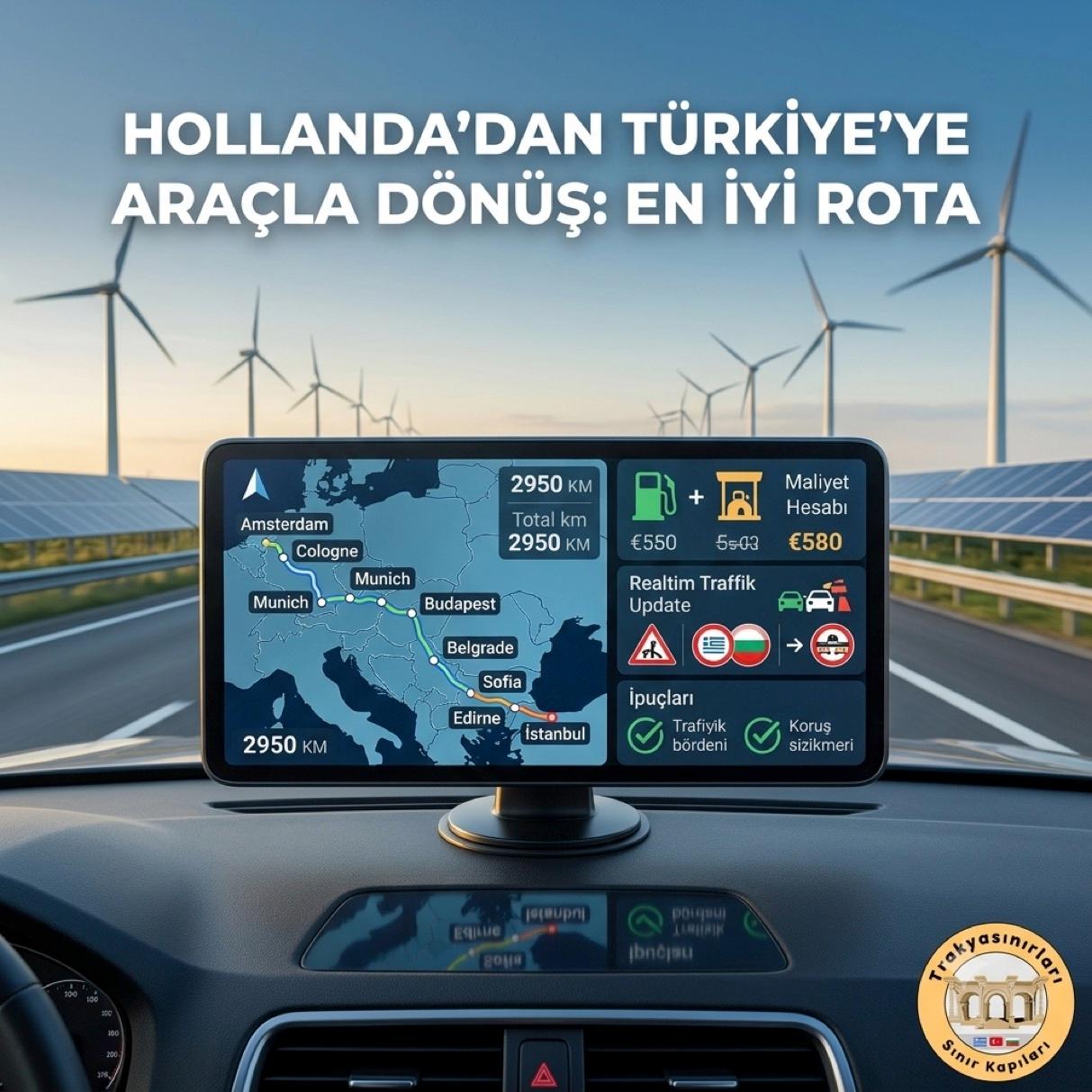
For the tens of thousands of Turks living in the Netherlands (in Amsterdam, Rotterdam, The Hague, Utrecht and every other city), each summer marks the start of the excitement of going home. Starting on the North Sea coast and stretching to the Mediterranean or Aegean shores, the heart of Central Anatolia or the green Black Sea region, this journey is one of the longest road adventures in Europe. For Turkish expats, the "Sıla Yolu Netherlands 2026" trip means not only covering the kilometres but also managing the budget well, choosing border crossings strategically and completing all legal formalities.
A trip starting in the Netherlands means roughly 300-400 kilometres more driving than the routes through the heart of Germany. This makes managing fatigue and optimising costs even more critical. For drivers searching for "Netherlands to Turkey by car", we have compiled the latest motorway conditions for 2026, vignette prices, alternative border crossings and fuel-saving tactics. At trakyasinirlari.com we are with you on this long journey.
1. Introduction: A Sıla Yolu Guide for Turks Living in the Netherlands
Because of its location, driving from the Netherlands to Turkey means crossing Europe from west to east along its full length. Drivers essentially have three different route corridors ahead of them. The first is the Croatia–Slovenia line through the southern Balkans, the second is the classic Central European line that relies on Hungary's motorway comfort, and the third is the Romania corridor, a lifeline when Serbian customs are congested.
When planning a good journey, before you set off you should have your car fully serviced, complete the digital registrations for the vignette systems and keep track of changing traffic at the border crossings. Let us now take a close look at the technical details, distance analyses and crossing dynamics of these 3 main routes.
2. Route 1 (Classic): Netherlands → Germany → Austria → Slovenia → Croatia → Serbia → Bulgaria → Kapıkule
This is the route the Dutch-Turkish diaspora has always been most familiar with, and the one satnavs usually suggest first. It allows almost uninterrupted driving on motorway-standard roads.
Distance and Estimated Driving Time
Starting from the central Netherlands, the total distance on this route to Kapıkule near Edirne is about 2,500 km. Even assuming no waiting at the border crossings, the net driving time while keeping to the speed limits is 28 to 32 hours. On this route it is essential for road safety that at least two drivers take turns at the wheel or that you plan an overnight stay in a safe hotel.
Motorway Charges and Toll Systems
Motorway policies vary widely between the countries on this route:
- Germany: Motorways from the Dutch border to the Austrian border are completely free. On autobahn stretches without a speed limit, avoid unnecessarily high speeds to keep fuel consumption in check.
- Austria & Slovenia: Both countries use a vignette (sticker) system. The Slovenian vignette can easily be bought online for a fixed period (weekly/monthly). In addition, some tunnels in Austria (the Tauern and Karawanken tunnels) charge an extra toll.
- Croatia & Serbia: A closed toll system applies: you take a ticket on entry and pay at the exit booth according to the distance travelled (in cash in euros or by credit card). For details, see our Croatia border crossings page.
- Bulgaria: Buy an e-vinetka as soon as you cross the border; camera-based number plate checks are extremely strict.
Order of Border Crossings
On this route, the points that challenge Turkish expats the most are the Schengen external borders and the transit zones. You reach Turkey by crossing, in order, Bregana (Croatia–Slovenia; a Schengen internal border since 2023, although Slovenia sometimes applies temporary checks), Batrovci / Bajakovo (Serbia–Croatia; Schengen external border) and Gradina / Kalotina (Serbia–Bulgaria), the busiest point in the network of Serbia border crossings.
3. Route 2 (via Hungary): Netherlands → Germany → Austria → Hungary → Serbia → Bulgaria → Kapıkule
This is the route for drivers who want to avoid the high motorway and toll costs of Slovenia and Croatia and who prefer flatter plains to Balkan mountain roads.
Distance and Advantages
This route is about 2,450 km from the Netherlands. It is roughly 50 kilometres shorter than the classic Croatia route. Its biggest advantage is that it saves you the high sums paid at Croatian motorway toll booths and completely bypasses the queues that can form at the Slovenia–Croatia border when Slovenia applies temporary internal border checks.
Border Crossings and Risks
The biggest bottleneck on this route is the Horgoš / Röszke crossing between Hungary and Serbia. In the summer season this crossing can grind to a complete halt. As an alternative, smaller crossings such as Tompa, Bački Breg or Rastina can be tried. We recommend keeping our Hungary border crossings guide open during the trip for Hungarian road conditions and alternative crossing points.
4. Route 3 (Romania Alternative): Netherlands → Germany → Austria → Hungary → Romania → Bulgaria → Kapıkule
Especially in mid-July, on the busiest days of the holiday season, the "Netherlands to Turkey via Romania" option stands out among Turkish expats as a life-saving alternative.
Distance and Road Quality
The total distance rises to around 2,600 km, making it the longest option of the three. Because part of Romania's motorway network is still under construction or consists of single-lane mountain roads, driving comfort is lower and the journey can take 34-36 hours.
Why Choose It?
At times when 10-12-hour queues build up at Serbian customs, going through Romania, a full Schengen member since 2025, may add kilometres but eliminates the hours spent at customs. Using the bridge and ferry crossings on the Romania–Bulgaria border, you can easily connect to Bulgaria and from there to Turkey. For the latest crossing details, see our Romania border crossings page.
5. Kapıkule or Hamzabeyli? (Advice for the Dutch-Turkish Diaspora)
Almost all cars setting off from the Netherlands head straight for Kapıkule. But the most critical decision of the "driving from the Netherlands to Turkey" journey is made precisely on the last bend in Bulgaria.
The extreme congestion at Kapıkule in the summer season wears down Turks from the Netherlands who have already been on the road for 30 hours. Our biggest piece of advice at Trakyasınırları for the diaspora is always to keep the Hamzabeyli border crossing option on the table while in Bulgaria. Turning off towards Hamzabeyli via Bulgaria's Lesovo/Elhovo road adds only 30-40 km, but saves you from the huge waits at Kapıkule and puts 5-8 hours straight back in your pocket.
6. Fuel Cost Comparison and Saving Strategy
The Netherlands is one of the countries with the most expensive fuel (especially petrol) in Europe. How you manage your fuel tank at the start of the journey therefore has a direct effect on your budget.
Cost Difference: At approximate November 2026 prices, petrol costs around €1.85 per litre in the Netherlands, while in Bulgaria, which you cross during the trip, the price drops to around €1.25. In Turkey the price per litre is in the ₺44.50 (about €1.30) range. Check current prices on the road.
Strategy: It makes sense to leave the Netherlands with only enough fuel to reach Germany, and then to use the relatively cheaper off-motorway stations (Autohof) in Germany. Do your biggest refuelling right after crossing the Bulgaria border crossings, at reliable international fuel stations inside the country. You can check the constantly changing international prices in our Fuel prices guide.
7. Vignette and Toll Charges 2026: Table
The standard vignette and motorway costs on the Netherlands–Turkey route (Route 1 – Classic) are summarised below:
| Country | Charge Type | 2026 Average Price | How to Buy |
|---|---|---|---|
| Germany | Free | €0.00 | - |
| Austria | 10-day vignette + tunnels | Current price + tunnel tolls | Asfinag digital or border toll booth |
| Slovenia | Weekly / monthly vignette | Current price | Official e-vinjeta website |
| Croatia | Toll booths (distance-based) | See the calculator | Cash or card at the booth |
| Serbia | Toll booths (distance-based) | See the calculator | Cash or card at the booth |
| Bulgaria | Weekly e-vinetka | Current price | BGTOLL app or customs post |
Work out which vignettes you need for your route and dates, together with tolls and fuel, with the Sıla Yolu cost calculator; official prices country by country are on the vignette prices page.
8. Practical Tips: Rest Plan and Documents
- What About the Ferry? Some Turkish expats ask about the Italy–Greece ferries of previous years. For a route starting in the Netherlands, however, this option is both very expensive and a waste of time (Scandinavian lines such as Kiel–Gothenburg are no help for these routes either). The road is the most sensible solution.
- Documents: Carry your Dutch residence card (Verblijfstitel), your Turkish passport or your dual citizenship documents obtained via e-Devlet (the Turkish government portal). Check that the codes of all the Balkan countries you will pass through are open (not crossed out) on the car's insurance document (Green Card).
- Rest Stops: Take your sleep breaks at well-known branded service areas on the Serbian motorway or at large chain fuel stations. Your personal safety and driving safety come before everything else.
9. Conclusion
However tiring it may seem, driving from the Netherlands to Turkey can become an enjoyable trip home with good planning, the right choice of route and close watch on customs. Before setting off in summer 2026, rather than entering a single route into your satnav, stay flexible according to the situation at the border crossings.
The Trakyasınırları team is at your service 24/7 so that you can follow the live situation at the border crossings throughout your trip. As you approach the border, be sure to look at the Kapıkule live camera images and make your final choice between Hamzabeyli and Kapıkule according to the queue. Have a good journey and a safe, trouble-free visit home!
Sources
The regulations, fees and procedures described on this page are based on the official sources below. Rules set by public authorities can change, so please check the latest information directly with the source.
- Entry/Exit System (EES) — traveller information — European Commission
Mandatory biometric registration at the Schengen border, the end of passport stamping, and the 90/180-day counter.
- Bulgarian electronic motorway vignette (e-vignette) — Bulgarian Road Infrastructure Agency
Vignette requirement, current tariffs and official online purchase.
- Romanian electronic vignette and bridge toll (rovinieta) — CNAIR — Romanian National Road Infrastructure Company
Rovinieta tariffs, validity periods and the Fetești–Cernavodă bridge toll.
- Motor Insurers’ Bureau of Turkey (Türkiye Motorlu Taşıt Bürosu) — Green Card insurance — Motor Insurers’ Bureau of Turkey
The countries where the Green Card is valid and the rules for issuing it.
Links last checked on 9 September 2026.